Peter’s blog ✴ Week 148 ✴ 17 January 2022
THE WEEKLY CHALLENGE
Numbers in words and Cardano triplets

Cardano triplets
Write a script to generate first 5 Cardano Triplets.
A triplet of positive integers (a,b,c) is called a Cardano Triplet if it satisfies this condition: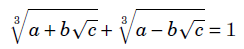
Examples
Example 1:
(2, 1, 5) is the first Cardano Triplet.
Analysis
Exactly how you order the triplets and thus determine which are the first 5 is not specified, but I took it to mean the first 5 if you order them by a + b + c.
I chose to do this by testing all possible triplets containing numbers up to 100, of which there are 1 million. By iterating first over c, then b, then a I saved a little time by calculating sqrt(c) only 100 times, and b * sqrt(c) only 10 000 times, but in fact that made little difference: my little Raspberry Pi did it in under 5 seconds with or without my optimisation (maybe because Perl does it anyway).
If we write the definition of the triplets in the form t1 + t2 = 1 it is interesting to look at the pattern. In every case t1 is >1 and t2 is thus negative, for example:
triplet (32, 11, 85) yields 5.10977222864644 +
   -4.10977222864644 = 1
There are some sets of triplets where their the t1 of each and thus the t2 of each are the same, for example:
(47, 40, 20)  → 6.09016994374947 + -5.09016994374947 = 1
(47, 80, 5)   → 6.09016994374947 + -5.09016994374947 = 1
(47, 20, 80)  → 6.09016994374947 + -5.09016994374947 = 1
(47, 16, 125) → 6.09016994374947 + -5.09016994374947 = 1
By inspection, it appears that there is only one (t1, t2) pair for a given a: that is, any triplets where a is, for example, 47, will have the same t1 and t2. That implies that they also share b * sqrt(c) and thus b**2 * c, and indeed from the 47 example:
b = 40, c= 20   so b**2 * c = 1600 * 20 = 32000
b = 80, c = 5   so b**2 * c = 6400 * 5  = 32000
b = 20, c = 80  so b**2 * c = 400 * 80  = 32000
b = 16, c = 125 so b**2 * c = 256 * 125 = 32000
From that pattern we can deduce that the following are also Cardano triplets:
(47, 10, 320) and (47, 5, 1280)
(47, 8, 500), (47, 4, 2000), (47, 2, 8000)
   and (47, 1, 32000)
To get those I took the original set of 47s and successively divided b by 2 and multiplied c by 4 until b was indivisible by 2 (with an integral result), and similarly multiplied b by 2 and divided c by 4 until c was indivisible.
Can we then say that we have identified all the triplets where a = 47? I postulate that this is the case.
It must be the case that any factor of 32000 that is a square will generate at least one triplet. The prime factors of 32000 are 2**8 * 5**3. So the possible square factors of 32000, ie the possible b**2s, are:
1, 4, 16, 64, 256, 25, 100, 400, 1600, 6400
... and thus the possible values of b are:
1, 2, 4, 8, 16, 5, 10, 20, 40 and 80
... and all of these are in the original set (for which I only searched a, b, and c up to 100), or in the 6 others that I deduced.
But remember that I postulated that all triplets with a = 47 have the same t1 and t2. I can't prove that, although the evidence suggests that it is the case.
So could we do the same for, say a = 48? At this point I can't see (a) how we could do that, or (b) prove whether in fact any triplets exist for a = 48, but I leave that - as one of my textbooks used to say - as an exercise for the reader.
Perl Weekly’s review
Peter choose to discuss his Cardano Triplets solution. Thanks for sharing your knowledge.
This review may cover either or both challenges for this week.
Script
#!/usr/bin/perl

# Peter Campbell Smith - 2022-01-10
# PWC 148 task 2

use v5.28;
use warnings;
use strict;
use utf8;

my ($a, $b, $c, $sqrt_c, %results, $cardano, $sum, $answer, $term1, $term2, $j, $b_sqrt_c);

# try 1 million possibilities - probably overkill!
for $c (1 .. 100) {
    $sqrt_c = sqrt($c);
    for $b (1 .. 100) {
        $b_sqrt_c = $b * $sqrt_c;
        for $a (1 .. 100) {

            # need to allow for imprecision in floating point operations
            $term1 = cbrt($a + $b_sqrt_c);
            $term2 = cbrt($a - $b_sqrt_c);
            if (abs($term1 + $term2 - 1) < 1e-10) {
                $results{sprintf('%06d¦%s', $a + $b + $c,
                    qq[$a, $b, $c :: $term1 + $term2 = 1])} = 1;
            }
        }
    }
}

# sort and print results in ascending order of a + b + c
$j = 0;
say qq[\nFirst 5 Cardano triplets];
for $cardano (sort keys %results) {
    ($sum, $answer) = split('¦', $cardano);
    say $answer;
    say qq[\n... and some more] if ++$j == 5;
}

sub cbrt {

    # cube root
    my $arg = $_[0];
    if ($arg >= 0) {
        return $arg ** (1 / 3);

    # cube root of -x is minus cube root of x
    } else {
        return -((-$arg) ** (1 / 3));
    }
}
6 lines of code
Output from script
First 5 Cardano triplets
2, 1, 5 :: 1.61803398874989 + -0.618033988749895 = 1
5, 2, 13 :: 2.30277563773199 + -1.30277563773199 = 1
8, 3, 21 :: 2.79128784747792 + -1.79128784747792 = 1
17, 18, 5 :: 3.85410196624968 + -2.85410196624968 = 1
11, 4, 29 :: 3.19258240356725 + -2.19258240356725 = 1

... and some more
17, 9, 20 :: 3.85410196624968 + -2.85410196624968 = 1
14, 5, 37 :: 3.54138126514911 + -2.54138126514911 = 1
5, 1, 52 :: 2.30277563773199 + -1.30277563773199 = 1
17, 6, 45 :: 3.85410196624968 + -2.85410196624968 = 1
20, 7, 53 :: 4.14005494464026 + -3.14005494464026 = 1
23, 8, 61 :: 4.40512483795333 + -3.40512483795333 = 1
44, 45, 13 :: 5.90832691319598 + -4.90832691319598 = 1
26, 9, 69 :: 4.65331193145904 + -3.65331193145904 = 1
47, 40, 20 :: 6.09016994374947 + -5.09016994374947 = 1
29, 10, 77 :: 4.88748219369606 + -3.88748219369606 = 1
32, 11, 85 :: 5.10977222864644 + -4.10977222864644 = 1
47, 80, 5 :: 6.09016994374947 + -5.09016994374947 = 1
35, 12, 93 :: 5.32182538049648 + -4.32182538049648 = 1
47, 20, 80 :: 6.09016994374947 + -5.09016994374947 = 1
71, 72, 21 :: 7.37386354243376 + -6.37386354243376 = 1
71, 36, 84 :: 7.37386354243376 + -6.37386354243376 = 1
98, 99, 29 :: 8.57774721070176 + -7.57774721070176 = 1
Any content of this website which has been created by Peter Campbell Smith is in the public domain